Sunday, February 17, 2013

Sunday, February 3, 2013
The Affordable Care Act's Impact on Education
After just attending a seminar on the “Affordable Care
Act” provided by Brown and Brown Insurance, I walked out with more questions
than answers… not because of the presentation and material covered, that was
top notch quality time well spent; but because of the sheer volume and speculation
of how the government’s massive entitlement program will eventually change the
landscape of Health Insurance offerings for school districts and where we fall
relative to the implementation timelines and penalties.

How this plays out remains to be seen; however, one inescapable fact remains…. It’s coming and we better prepare for change as we as School Business Administrators like all other business leaders in all sectors of the market will be responsible for implementing, overseeing and managing that change.
The health care law offers clear choices for consumers and provides new ways to hold insurance companies accountable. The most important parts of the law are broken into groups below. We’ll highlight new features of the law here as they roll out between now and 2014.
Key Provisions of the Affordable Care Act
The Affordable Care Act includes a variety of measures specifically for small businesses that help lower premium cost growth and increase access to quality, affordable health insurance. Depending on whether you are self-employed, an employer with fewer than 25 employees, an employer with fewer than 50 employees, or an employer with 50 or more employees, different provisions of the Affordable Care Act may apply to you. Learn about the key provisions of the Affordable Care Act based on the size of your business below.
Employers with 50 or More Employees
Key Provisions Under the Affordable Care Act for
Employers with 50 or More Employees

Implementation of the Affordable Care Act occurs in stages, with many of the reforms and requirements taking effect in 2013 and 2014. Some of the provisions that may impact employers with 50 or more employees include:
What Is a Health Exchange?
 Learn How Health Exchanges in Your State May Affect You
From Michael Bihari,
MD, former About.com Guide

The best line of the morning was, “The Affordable Care
Act is not Health Care reform… it is Health Care Insurance Reform” and that
reform is more mandates that fall on the shoulders of business to include
schools. Worse yet it will eventually force
unpopular staffing decisions that will have adverse income effects on hourly
workers leading to potential cutting of hours, reductions in force and or
outsourcing.
According to the Whitehouse, “The Patient Protection and Affordable
Care Act (Affordable Care Act or ACA) enacted comprehensive health insurance
reforms designed to ensure Americans have access to quality, affordable health
insurance.”
How this plays out remains to be seen; however, one inescapable fact remains…. It’s coming and we better prepare for change as we as School Business Administrators like all other business leaders in all sectors of the market will be responsible for implementing, overseeing and managing that change.
While the information and components of the program are sizable,
I have attached links to sites through my own research on the topic designed to
help guide us through the process.
Absent the presentation provided by Louis Della Penna Jr., Executive
Vice President of Brown & Brown Benefit Advisors, Inc., Lambertville, NJ,
we would again be heading into the change with little to no guidance from the
creators and enforcers of the plan… government albeit web information.
Key
Features of the Law
The health care law offers clear choices for consumers and provides new ways to hold insurance companies accountable. The most important parts of the law are broken into groups below. We’ll highlight new features of the law here as they roll out between now and 2014.
Key Provisions of the Affordable Care Act
The Affordable Care Act includes a variety of measures specifically for small businesses that help lower premium cost growth and increase access to quality, affordable health insurance. Depending on whether you are self-employed, an employer with fewer than 25 employees, an employer with fewer than 50 employees, or an employer with 50 or more employees, different provisions of the Affordable Care Act may apply to you. Learn about the key provisions of the Affordable Care Act based on the size of your business below.
Employers with 50 or More Employees

Implementation of the Affordable Care Act occurs in stages, with many of the reforms and requirements taking effect in 2013 and 2014. Some of the provisions that may impact employers with 50 or more employees include:
What Is a Health Exchange?
 Learn How Health Exchanges in Your State May Affect You
Updated April 04, 2010
A health exchange will be created in each
state by 2014. The health reform legislation (Patient Protection and Affordable
Care Act) signed into law in March 2010 by President Obama creates state-based
health insurance exchanges. States can choose to operate their own exchanges or
participate in a multi-state exchange.
Summary
of Potential Employer Penalties
Under
the Patient Protection and Affordable
Care Act (PPACA)
http://www.ncsl.org/documents/health/EmployerPenalties.pdf
Monday, January 28, 2013
iPads.... The Cost of Adding The Next Big Thing
Back in May I published a quick article on my Blog about the newest push in adding technology to the classroom... the iPad. While discussions were taking place across the country and perhaps throughout the world in advanced countries the predominate argument was on the value or perceived value with respect to delivery of instruction and value add in addressing the curriculum content standards at all levels. Absent that discussion was the associated costs of personnel to support and maintain such a roll out depending on the scale and overall cost of the plan.
 Specifically, the aggregate expenditure associated with a comprehensive plan to modernize the classroom phenom. As reported, "Schools across the nation are reaching for the iPad as the next big thing in classroom technology by equipping students with an interactive way to learn by instantly accessing information through apps and interactive tools."
With respect to the actual investment, roughly $500 - $550 per unit comes the cost of adding additional staff or redirecting existing staff to set up, program, maintain and repair. This comes in the form of either a new technician(s) and or computer teacher(s).
Case in point:
The 2013-2014 Technology budget for our district included 700 new iPads to introduce 2 grades per year (grades 3 & 6, the following two years the installation plan would continue at grades 3 & 6 until the 2015-2016 school year that would yield iPads for all students from grades 3 to 8. This would bring the total count to approximately 2,100 iPads to maintain with the added cost of recycling the first issue the following year. Another concern becomes what happens as the first group of eighth grades exit the middle school: Do they continue the knowledge and use of iPads into their secondary experience?
Some district's jumped out in front with a large purchases absent a planned infrastructure (network) upgrade to accommodate and operate the units at maximum efficiency. The end result is teachers left with the inability to perform basic online tasks because their wireless network is overwhelmed with the large number of additional devices. This diminishes or wipes out the return on investment leaving students with worthless units.
In the words of one Director of Technology, "We're able to do what we do now just barely because of our ability to remote in; however with the iPads, we do not have that ability and therefore require staff at each location or increase wait times as techs would need to be dispatched." "Just to get them on the wireless network, we have to take each unit one at a time to put on the network through settings."
Without adequate staff the initiative could stall or become less productive or unsuccessful.
If you put a new initiative out there that can not be properly supported, not only will it fail; it will have a detrimental and have lasting negative effect on the entire technology plan.
 Specifically, the aggregate expenditure associated with a comprehensive plan to modernize the classroom phenom. As reported, "Schools across the nation are reaching for the iPad as the next big thing in classroom technology by equipping students with an interactive way to learn by instantly accessing information through apps and interactive tools."
With respect to the actual investment, roughly $500 - $550 per unit comes the cost of adding additional staff or redirecting existing staff to set up, program, maintain and repair. This comes in the form of either a new technician(s) and or computer teacher(s).
Case in point:
The 2013-2014 Technology budget for our district included 700 new iPads to introduce 2 grades per year (grades 3 & 6, the following two years the installation plan would continue at grades 3 & 6 until the 2015-2016 school year that would yield iPads for all students from grades 3 to 8. This would bring the total count to approximately 2,100 iPads to maintain with the added cost of recycling the first issue the following year. Another concern becomes what happens as the first group of eighth grades exit the middle school: Do they continue the knowledge and use of iPads into their secondary experience?
Some district's jumped out in front with a large purchases absent a planned infrastructure (network) upgrade to accommodate and operate the units at maximum efficiency. The end result is teachers left with the inability to perform basic online tasks because their wireless network is overwhelmed with the large number of additional devices. This diminishes or wipes out the return on investment leaving students with worthless units.
In the words of one Director of Technology, "We're able to do what we do now just barely because of our ability to remote in; however with the iPads, we do not have that ability and therefore require staff at each location or increase wait times as techs would need to be dispatched." "Just to get them on the wireless network, we have to take each unit one at a time to put on the network through settings."
Without adequate staff the initiative could stall or become less productive or unsuccessful.
If you put a new initiative out there that can not be properly supported, not only will it fail; it will have a detrimental and have lasting negative effect on the entire technology plan.
Tuesday, January 1, 2013
Class Size Falling Victim to Shrinking Budgets
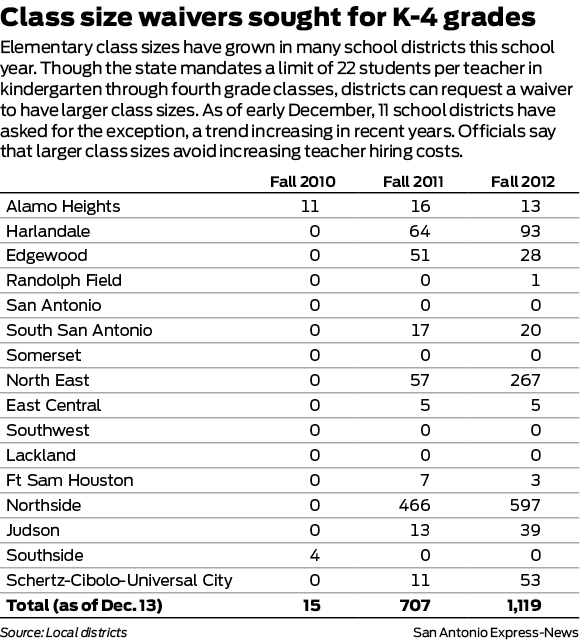
School classes grow as funding shrinks

 |
|
Clark High School teacher Nat Player has 39 students crowded into one
of his Advanced Placement psychology courses.
Photo: Helen L. Montoya, San Antonio Express-News /
©SAN ANTONIO EXPRESS-NEWS
|


The psychology teacher has one of the largest classes in Northside Independent School District, with 39 students taking one of his Advanced Placement courses. He has more work to grade and he can't use all the whiteboard — their desks block access to it.
But what worries him most is losing the ability to focus on each of them.
“It's just easier for kids to fall through the cracks, I think,” Player said. “I enjoy being able to get to know the students and better keep an eye on (them) if they need help or some attention, either with homework or just needing someone to talk to.”
In his 16 years at Clark, he has seen class sizes balloon, and the trend is accelerating. Students regularly haul desks from down the hallway into a French II class so they all can fit in, then take them back out for a smaller subsequent class.
Northside's predicament mirrors that of several other local districts with expanding enrollments. It's part of the argument hundreds of Texas districts are making in an ongoing school finance lawsuit against the state, blaming lawmakers for a funding scheme that doesn't keep up with growth.

But what worries him most is losing the ability to focus on each of them.
“It's just easier for kids to fall through the cracks, I think,” Player said. “I enjoy being able to get to know the students and better keep an eye on (them) if they need help or some attention, either with homework or just needing someone to talk to.”
In his 16 years at Clark, he has seen class sizes balloon, and the trend is accelerating. Students regularly haul desks from down the hallway into a French II class so they all can fit in, then take them back out for a smaller subsequent class.
Northside's predicament mirrors that of several other local districts with expanding enrollments. It's part of the argument hundreds of Texas districts are making in an ongoing school finance lawsuit against the state, blaming lawmakers for a funding scheme that doesn't keep up with growth.
Friday, December 21, 2012
Resources for schools to prepare for and recover from crisis
Resources for schools to prepare for and recover from crisis
FEMA Institute Emmitsburg, MD - District Officials received current safety/security training on Multi-Hazardous conditions to include, "ACTIVE SHOOTER"
Below: Paul Sears, SHS Principal, Myself, Business Administrator, Christopher Cotter, City Administrator, John Dougherty, Lt. Police, Angelo Palumbo, Manager of B&G, and Eric Evers, Btln Fire Commander
This course provided a comprehensive review and analysis of the importance, construct and need for planning, practice, training and testing of our comprehensive Emergency Management Plan (EOP).
Our cohort included groups from Unalaska, Alaska (aleutian islands-Dutch Harbor); Humble,Texas; Aurora, IL; and Stevens Point, WI, presenting a broad based perspective on emergency planning.

In order to maintain a high state of readiness to ensure life safety, Incident stabilization and preserve property, we need to put the plan into action through ongoing practice of drills, tabletops and full scale exercises.
FEMA Institute Emmitsburg, MD - District Officials received current safety/security training on Multi-Hazardous conditions to include, "ACTIVE SHOOTER"
Below: Paul Sears, SHS Principal, Myself, Business Administrator, Christopher Cotter, City Administrator, John Dougherty, Lt. Police, Angelo Palumbo, Manager of B&G, and Eric Evers, Btln Fire Commander
 |
| City of Summit EM Planning Group - April 2012 |
This course provided a comprehensive review and analysis of the importance, construct and need for planning, practice, training and testing of our comprehensive Emergency Management Plan (EOP).
Our cohort included groups from Unalaska, Alaska (aleutian islands-Dutch Harbor); Humble,Texas; Aurora, IL; and Stevens Point, WI, presenting a broad based perspective on emergency planning.

In order to maintain a high state of readiness to ensure life safety, Incident stabilization and preserve property, we need to put the plan into action through ongoing practice of drills, tabletops and full scale exercises.
Monday, December 17, 2012
BASIC SCHOOL SECURITY PROTOCOLS
In the wake of the recent tragedy experienced in Newtown, CT involving another school shooting, I am posting some basic security protocols that should be in place for all schools. Unfortunately, these and other measures such as perimeter checks and risk assessments of our buildings and grounds will not eliminate the potential for this unspeakable violence; however, they can and have worked to prevent, deter or minimize the loss of life.
SECURITY PROTOCOLS
SECURITY PROTOCOLS
1.
NEED TO KNOW BASIS: If
parents or public ask you questions about our safety policies and procedures,
please do not get specific. Specifics about safety procedures only need
to be known by students and staff.
Please do generally communicate that we do have safety procedures
in place, and that we take safety and security very seriously.
2.
CHALLENGE
All Persons or groups within the building and redirect to the main office if
unaccompanied or without an official visitors pass.
3.
ACCURATE ATTENDANCE EVERY SINGLE DAY. Accurate attendance is one of the most
important things you do each day. It is essential.
4.
REVIEW SAFETY PROCEDURES:
It is your responsibility to continuously review safety procedures. Lock downs, fire drills, and evacuation
procedures are something we all need to know backwards and forwards.
5.
CLASS ROSTERS: Always bring class
rosters with you during ALL evacuation drills and take attendance.
6.
TAKE DRILLS SERIOUSLY!
When we do drills, take them seriously and do all you can to get the
students to do so as well. There should
be NO talking or sounds coming from classrooms during lockdown drills.
7.
NEVER prop exterior doors
open, or let someone come in through a non-main-entrance door, unless they
are first responders or accompanied by a staff member.
8.
IF YOU SEE SOMETHING…SAY SOMETHING:
REPORT violations of safety protocols, emergencies, and anything suspicious
to the building Principal.
Sunday, December 16, 2012
Longevity's Time has Expired
Nothing drives me crazier than dealing with longevity in labor agreements! Many collective bargaining agreements (CBAs) in the public sector both municipal and educational, have employees that receive contracted adjustment increases each year based on a flat amount or percentage of their salary.
While longevity made sense in its day as a method of acknowledging years of service and more importantly serving to entice the employee to stay in lower paid public sector jobs vs. leaving for a more lucrative opportunity in the private sector; its rationale is gone.
In the words of Gene Raskin who put English lyrics to the Russian romance song "Dorogoi dlinnoyu," "Those Were the Days" ... "we though they'd never end," ... apparently they didn't!
1975
Average Salaries (National Secretaries Association membership survey)
$9,000-$11,000 32%
$11,000-$13,000 17%
$13,000-$15,000 7%
$15,000 and over 4%
60% reported salaries of $9,000 or more.
The worst part of this lopsided initiative is the fact that at inception the percentage method agreed to by governing bodies seemed harmless as the salaries of the day were ranging from the low to mid teens in the 70's and administrative salaries were closer to forties. Therefore, even at 5% the yield could range from $450 - $750. Not very alarming on a salary of $11,000 that received a total adjustment after say a 3% raise to $11,897.
Compared to today, that secretary is closer to $60,000 and probably looking at a 2% raise with the same 5% longevity costing $3,000 bringing the total salary to $64,200.
The real issue is ...given the state of the economy in the private sector with salary freezes, downsizing and cuts/elimination of benefits, these employees are not going anywhere. Longevity has been stopped in many contracts by grandfathering existing staff; however, given the fiscal constraints of tighter budgets one must consider the need repeal and abolish the practice, especially the percentages as the dollars sky rocket as the base has more than doubled or even tripled since the practice began. In some cases you can have a six figure salary receiving a 5% or more longevity stipend which yields an instant $5,000 increase before even considering a raise.
While longevity made sense in its day as a method of acknowledging years of service and more importantly serving to entice the employee to stay in lower paid public sector jobs vs. leaving for a more lucrative opportunity in the private sector; its rationale is gone.
In the words of Gene Raskin who put English lyrics to the Russian romance song "Dorogoi dlinnoyu," "Those Were the Days" ... "we though they'd never end," ... apparently they didn't!
 |
| Data based on research surveys from the International Association of Administrative Professionals (IAAP) and/or other sources as noted |
Average Salaries (National Secretaries Association membership survey)
$9,000-$11,000 32%
$11,000-$13,000 17%
$13,000-$15,000 7%
$15,000 and over 4%
60% reported salaries of $9,000 or more.
The worst part of this lopsided initiative is the fact that at inception the percentage method agreed to by governing bodies seemed harmless as the salaries of the day were ranging from the low to mid teens in the 70's and administrative salaries were closer to forties. Therefore, even at 5% the yield could range from $450 - $750. Not very alarming on a salary of $11,000 that received a total adjustment after say a 3% raise to $11,897.
Compared to today, that secretary is closer to $60,000 and probably looking at a 2% raise with the same 5% longevity costing $3,000 bringing the total salary to $64,200.
The real issue is ...given the state of the economy in the private sector with salary freezes, downsizing and cuts/elimination of benefits, these employees are not going anywhere. Longevity has been stopped in many contracts by grandfathering existing staff; however, given the fiscal constraints of tighter budgets one must consider the need repeal and abolish the practice, especially the percentages as the dollars sky rocket as the base has more than doubled or even tripled since the practice began. In some cases you can have a six figure salary receiving a 5% or more longevity stipend which yields an instant $5,000 increase before even considering a raise.
Saturday, December 15, 2012
NJASBO School Development Authority Committee Work
 |
NJ School Development Authority
Trenton Office
|
Over the past eight years I have been planning and managing facility projects through state facility grants. The reimbursement process for all section 15 grant agreements going back as far as 2004 and carrying through into the current RODs (Regular Operating District's)Grants established in late 2008 2009 have proven to be an effective way to address critical facility needs at a significant savings of forty cents on the dollar or 40% from the state through direct reimbursement of final eligible costs (FEC) as determined by the NJDOE Office of Facilities.
While impressive and vital to the continuation of these projects, the reimbursement process is best described as arduous requiring a paper chase of duplicative and labor intensive clerical work that often delays the actual receipt of the much needed funding.
With reimbursable grants, districts and or municipalities in Type I districts typically bond only the "local share" or 60% of the final approved project and issue short term notes for the "state share." In reality, since reimbursement is only made after major milestones of project completion, this could roll into years as a typical project can span two or more fiscal school years as construction must be planned around the school day.
Recognizing and experiencing this fact with many of my colleagues the discussion became a focus area at our NJASBO (Association of School Business Officials) state meetings leading to the formulation of the SDA Committee with me as chair at the suggestion of John Donahue, Executive Director NJASBO.
Over the past four months we have met with Marc D. Larkins, CEO; Jason E. Ballard,
Chief of Staff; and Andrew D. Yosha, Vice President Chief of Operations.
The
committee’s goals are as follows:
1.
Streamline
the approval process to effectuate prompt payment to districts for RODS grants
2.
Simplify
the process by converting PDF documents to Word and or Excel
3.
Improve
communications between the SDA project specialists and district representatives
throughout the process
4.
Address
the need for information sharing between the NJDOE Office of Facilities and the
NJSDA in an attempt to eliminate duplicative requests for information from
districts on approved projects.
Subscribe to:
Posts (Atom)